



 5 Min
5 Min In Clinical

Follow this topic

Bookmark

Record learning outcomes
By Professor Paul Rutter, University of Portsmouth
Hypothesis generation
Generalised rashes provide a diagnostic challenge because many different conditions produce similar rashes, meaning diagnostic errors are common.
Listed below are causes of generalised rash that a community pharmacist may encounter – well over 30 conditions!
Likely diagnosis
- Contact dermatitis
- Discoid eczema
- Drug eruption
- Folliculitis
- Insect bites
- Keratosis pilaris
- Pityriasis rosea
- Plaque psoriasis
- Scabies
- Seborrhoeic dermatitis
- Seborrhoeic keratosis
- Tinea corporis
- Urticaria
- Viral infections: chicken pox, Fifth disease (erythema infectiosum), Sixth disease (roseola).
Possible diagnosis
- Atopic dermatitis
- Dermatitis herpetiformis
- Guttate psoriasis
- Lichen planus
- Lyme disease
- Lupus
- Miliaria rubra
- Mycosis fungoides
- Viral infections (rare): German measles, measles, scarlet fever.
Critical diagnosis
- Bullous pemphigoid
- Erythema multiforme.
Key points
- Generalised rash is very common and there are multiple possible causes
- Misdiagnosis is common, so good safety netting is vital.
Shortening the list
We need to think about how this long list can be shortened before asking questions. We know our patient is in his 40s. On that basis, we can rule out, for now, conditions associated with the young and the old:
- Younger age groups: guttate psoriasis, keratosis pilaris, pityriasis rosea and viral xanthems
- Older age groups: seborrhoeic keratosis, bullous pemphigoid, mycosis fungoides.
We know that the rash itches and the patient has been taking an antihistamine. Therefore, we can discount rashes where itch is rare or absent, namely: seborrhoeic dermatitis, Lyme disease and miliaria (heat rash).
Drug-induced skin rash can also be eliminated. However, this still leaves a large number of conditions to consider:
- Atopic dermatitis
- Contact dermatitis
- Dermatitis herpetiformis
- Discoid eczema
- Folliculitis
- Insect bites
- Lichen planus
- Lupus
- Plaque psoriasis
- Scabies
- Tinea corporis
- Urticaria.
Continued information gathering
Having knowledge of what the rash looks like will further help you to reduce the number of possible conditions. You ask the patient if you could see the rash on his legs as this is where he first noticed it.
On inspection, you can see that it is on both legs below the knee. There are a number of lesions, each between 1-2cm in diameter. Knowing the size of the lesions is helpful as conditions that are pinpoint or less than 1cm can be ruled out. These include folliculitis, lichen planus, scabies and insect bites.
Problem refinement
If you then think about the look of the lesions, you can see that they are raised, show slight scale and are annular. Based on this information, urticaria and dermatitis herpetiformis can be discounted.
The other information you have is that the rash is on the patient’s legs and arms. You ask if he has noticed the rash elsewhere, and he says no. The location then more strongly points to a diagnosis of contact dermatitis, discoid eczema or atopic dermatitis.
You ask if he ever had any childhood problems with his skin. He tells you that he does not recall having any issues. The lack of a personal history seems to rule out atopic dermatitis. This leaves discoid eczema or contact dermatitis as the possible diagnoses.
Contact dermatitis is usually triggered by something, but when you ask about this, the patient cannot recall anything different that he has come into contact with. This leaves discoid eczema as your differential diagnosis.
Red flags
This patient does not show any signs of erythema multiforme.
Management
Self-care
As in all cases of dermatitis/eczema, making sure the skin is kept moist is important, so the patient could use an emollient as frequently as needed.
Prescribing
Steroids are the mainstay of treatment. However, OTC hydrocortisone is unlikely to work and more potent steroids are generally required.
Pharmacists with prescribing rights should consider a potent or very potent steroid.
Safety netting
You tell the patient that you think his rash is discoid eczema and he will need a steroid cream or ointment. This should get rid of the rash but he may be prone to get flare-ups as this is not a cure.
You advise him to see his GP as OTC steroids are probably not strong enough to help. He should see improvement in a week or so but it may be a few weeks before the lesions clear up.
If he sees no benefit from the prescribed steroid after two weeks, he should go back to his doctor.
Common causes of generalised rash
Conditions ruled out on the basis of age are not included.
Contact dermatitis: causes redness, drying of the skin and irritation, as well as possible papules and vesicles. Itching is a prominent feature and often causes the patient to scratch, which results in broken skin with subsequent weeping.
In chronic cases, the skin becomes dry and scaly and can crack and fissure. In the acute phase, lesions tend to appear rapidly, within six to 12 hours of contact and the rash tends to be well demarcated.
Common causes include cosmetics, topical medications, metal, latex, textiles, dyes, sunscreens and cement.
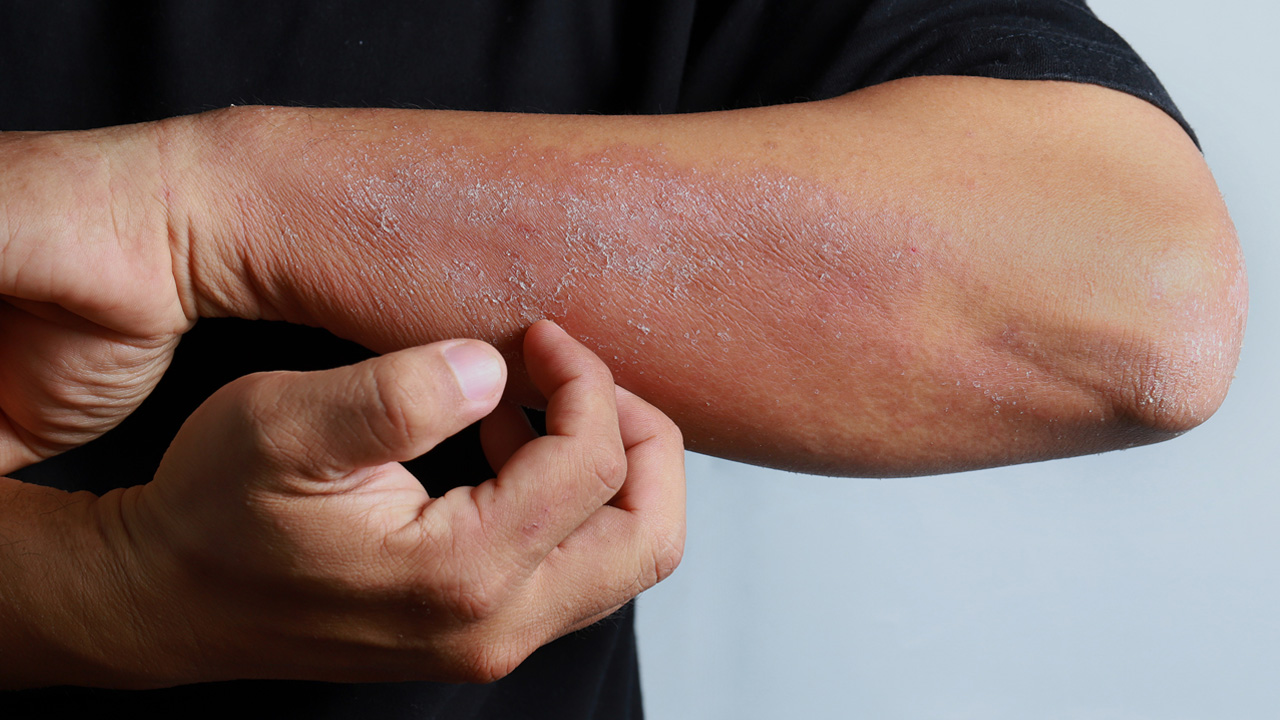
Discoid eczema: raised, scaly, coin-shaped itchy red/brown lesions (1-3cm in diameter) particularly affect the legs but also the arms, flanks, hips, hands and feet.
They often occur symmetrically and over time can show central clearing. More common in middle-aged people.
Drug eruption: typically, a maculopapular rash is seen and often affects the face, hands and feet. Can be caused by a number of medicines but particularly allopurinol, beta-lactam antibiotics, sulfonamides, anticonvulsants, ACE inhibitors, non-steroidal anti-inflammatory drugs, hypoglycaemics and thiazide diuretics.
Folliculitis: can be due to infection, occlusion, irritation or skin disease. Often seen when hairs regrow following activities such as waxing or shaving. Multiple small pustules localised to hair follicles is the typical presentation.
Insect bites: itching papules, often intense, is the hallmark symptom. Occasionally, these blister as a result of scratching. Bites tend to be in groups, are asymmetrical and occur on exposed areas.
Plaque psoriasis: characteristic salmon-pink round or oval lesions with silvery-white scales and well-defined boundaries. On darker skin, this colour is not apparent.
Typically affects elbows, knees, scalp, central trunk, umbilicus, genitalia, lower back or gluteal cleft, often symmetrically distributed.
If the scales on the surface of the plaque are gently removed, it will reveal pinpoint bleeding points from the superficial dilated capillaries. This is known as the Auspitz sign and is diagnostic.
Scabies: severe generalised pruritus, especially at night, is the hallmark symptom. Lesions are typically seen on wrists, interdigital spaces of the fingers and extensor aspects of limbs as well as penile and scrotal skin in men and beneath the breasts and nipples in women.
The rash typically shows small red papules, and the surrounding skin is often sore and damaged due to itching.
Seborrhoeic dermatitis: characterised by a history of intermittent skin problems.
Distribution of the rash is typically symmetrical, affecting the central part of the face, scalp, eyebrows, eyelids, ears, nasolabial folds and mid-chest. The rash is red and non-itchy, with greasy-looking scales.
Tinea corporis: usually presents as asymmetrical, itchy pink or red, scaly, slightly raised annular patches with a well-defined inflamed border, which enlarge outwards.
Over time, lesions often show central clearing. Lesions range in size and occur singly or can be numerous.
Urticaria (or hives): round or oval lesions of variable size are discrete and confluent, raised, itchy and oedematous. They may have an erythematous border (flare) and pale centre (wheal).
Often, the patient will have a history of drug, food or substance exposure.
Atopic dermatitis: can take a variety of forms. It may continue in the school-age flexural pattern or become diffuse. Characterised by dry skin, pruritus, erythema, excoriations, scaling and lichenification.
Dermatitis herpetiformis: intense itchy clusters of papules and vesicles in a symmetrical distribution. Commonly involves the buttocks, elbows, knees, and sacral region. Most common in middle-aged men. Most patients have coeliac disease.
Lyme disease: a tick-borne condition. Typically, there is a spreading, red/purple flat rash with a defined border at the site of the bite. As the rash spreads, it develops a characteristic ‘bulls eye’ appearance. There may also be flu-like symptoms.
Lichen planus: shiny, slightly raised, pink or purple/red small lesions that may show fine white streaks (Wickham striae). Can be anywhere but mostly affects the insides of the wrists, the ankles and lower back. Itch may be absent but it usually itches, which can be severe.
Oral buccal mucosal lesions affect around 20 per cent of patients and appear as white, slightly raised lesions like a spider’s web.
Lupus (sub-acute cutaneous lupus erythematosus): raised annular lesions with central clearing, mainly on the trunk and sun-exposed areas such as face and arms. Uncommon. Mostly affects women between the ages of 20 and 50 years.
Critical diagnosis
Erythema multiforme: Lesions begin on the hands and feet before spreading up the limbs to the trunk and face. Typically precipitated by infection, it presents small, round, slightly raised red areas, some of which turn into circular lesions appearing as three concentric rings.
Oral mucosal involvement is also common, presenting as shallow white ulcers. Prodromal symptoms of fever and headache, and feeling unwell, may be present.
1. An adult presents with a generalised, moderate/severe pruritic rash and a history of close contact with an affected individual. Which ONE of the following conditions is most likely?
a. Atopic dermatitis
b. Discoid eczema
c. Scabies
d. Tinea
e. Urticaria
2. A 30-year-old man presents with a ‘herald patch’ on his back, which was then followed by a generalised rash. Which ONE of the following is the most likely diagnosis?
a. Atopic eczema
b. Pityriasis rosea
c. Psoriasis
d. Seborrhoeic dermatitis
e. Tinea corporis
3. A 21-year-old woman presents with a generalised maculopapular rash with a history of recent use of amoxicillin for a sore throat. Which ONE of the following is the most likely diagnosis?
a. Contact dermatitis
b. Drug eruption
c. Erythema multiforme
d. Guttate psoriasis
e. Lupus
4. A 33-year-old patient presents with a generalised scaly rash involving the extensor surfaces that are
well-demarcated plaques. Which ONE of the following is the most likely diagnosis?
a. Drug eruption
b. Pityriasis rosea
c. Psoriasis vulgaris
d. Seborrhoeic dermatitis
e. Urticaria
5. A 28-year-old presents with a non-itchy generalised pink rash that follows a ‘Christmas tree’ pattern on the trunk. Which ONE of the following is the most likely diagnosis?
a. Contact dermatitis
b. Drug-induced rash
c. Lichen planus
d. Pityriasis rosea
e. Psoriasis
Answers: 1.c 2.b 3.b 4.c 5.d
Useful websites
- British Association of Dermatologists: bad.org.uk/pils/discoid-eczema
- National Eczema Society: eczema.org
- Dermatology Information System (images, differential diagnoses and case reports on almost all skin diseases): dermis.net
Continued information gathering
We know the patient’s symptoms are only affecting his left ankle area. This is very useful in narrowing down our thinking as a number of likely conditions cause bilateral ankle swelling and can therefore be discounted. These include heart failure, medicines and venous insufficiency. All possible diagnoses are also bilateral. We are therefore looking at cellulitis, DVT, bites or trauma as the cause of his ankle swelling.
Trauma and bites can be easily assessed. A history of a recent trip or fall will establish if trauma is the cause, and an inspection of the ankle should reveal signs of the patient being bitten. An examination reveals no obvious signs of bites and the patient says he has not fallen or hurt his ankle recently.
This suggests that we are dealing with a DVT or cellulitis. While DVTs are more associated with calf swelling, they can occur around the ankle.
Problem refinement
Both DVT and cellulitis will have an acute presentation associated with redness, warmth, tenderness/pain over the affected area. However, cellulitis should also show systemic symptoms such as malaise and fever, which may proceed swelling.
You ask the patient about his general health. He tells you that he feels okay but not 100 per cent himself. You ask when he started to feel like this, and he tells you it has been over the last two or three days. This is consistent with ‘malaise-like’ symptoms associated with cellulitis.
You make a diagnosis of cellulitis.
Red flags
This patient has not complained of marked systemic symptoms, or swelling that is causing severe pain, which might suggest worsening infection requiring onward referral for further evaluation.
Management
Self-care
Analgesia can be recommended for pain, and the patient could elevate his leg to help relieve the swelling.
Prescribing options
Antibiotics are recommended. Flucloxacillin 500-1000mg qds for up to seven days should be given – unless the patient has a penicillin allergy, in which case doxycycline would be an alternative. Clarithromycin should be avoided due to potential interaction with his statin.
Safety netting
You tell the patient that his swelling is due to an infection, and a course antibiotics should get rid of the problem. However, if he feels poorly or his symptoms get worse over the next two or three days, he needs to come back and see you.

Share:


In Clinical
Let’s get clinical. Follow the links below to find out more about the latest clinical insight in community pharmacy.